If you’re comparing dentures vs implant-supported dentures, the upfront costs can feel worlds apart. But the initial price is only one factor to consider when deciding which option may fit your needs.
Traditional dentures generally have a lower upfront cost, while implant-supported dentures require a larger initial investment.
Long-term costs for either option depend on maintenance, repairs, replacement needs, and the patient’s individual treatment plan.
That’s not a guarantee for everyone. Your bone health, how many implants you need, and how well you keep up with maintenance all shift the math.
Nobody wants a surprise bill two years into a new denture, and nobody wants to overpay for implants they didn’t truly need.
The right answer depends on specifics you can actually plan around, not guesswork.
Key Takeaways
- Traditional dentures cost less to start, but relines and replacements add up over 10 to 20 years.
- Implant-supported dentures cost more upfront, with snap-in and fixed options priced differently based on how many implants and attachments they use.
- Whether you choose removable or fixed implants all change which option saves you money over time.
How Much Does Each Option Cost Upfront?
Traditional dentures generally have a lower upfront cost than implant-supported dentures.
Implant-supported options require surgical implant placement and additional components, so the initial investment is typically higher.
Implant treatment costs also vary considerably depending on whether you are replacing one tooth or an entire arch, how many implants are needed, and whether additional procedures are part of the treatment plan.
What Is Included in a Traditional Denture Quote?
A denture quote usually covers the impressions, the fitting appointments, and the finished set of complete dentures or partial dentures.
It may or may not include extractions if you still have teeth that need to come out first.
Ask whether follow-up adjustments in the first few months are part of the price, since early sore spots are common while your mouth adjusts to a new denture fit.
What Is Included in an Implant-Supported Denture Quote?
An implant-supported denture quote needs to spell out the surgical placement of each implant, the abutments, and the denture itself.
Many practices also require a CBCT scan before treatment to map your jawbone in three dimensions, and that imaging fee sometimes appears as a separate line item.
If your dental implant cost estimate doesn’t mention imaging, sedation, or the number of implants planned, ask before you sign anything.
How Can Financing Affect Your Treatment Decision?
Financing options may make it easier to spread treatment costs over time rather than paying the entire amount upfront.
Before choosing between traditional and implant-supported dentures, ask the dental office which financing options are available and how they may apply to your treatment plan.
Which Option Costs Less Over 10 or 20 Years?
Looking only at the initial price does not account for maintenance that may occur over time.
Traditional dentures can require relines, adjustments, repairs, or replacement, while implant-supported dentures have their own maintenance needs involving attachments and prosthetic components.
Which option costs less over the long term depends on the original treatment, maintenance needs, repairs, replacement requirements, and how long each restoration remains functional.
What Assumptions Make a Long-Term Comparison Fair?
A fair comparison has to use the same arch, the same starting condition, and the same region’s pricing for both options.
Comparing a single denture arch to a full-mouth implant case isn’t a fair fight. For this example, assume one arch, average mid-range pricing, and a patient starting with no major bone loss.
Here’s how the two options can differ in upfront and long-term costs:
| Factor | Traditional Dentures | Implant-Supported Dentures |
| Initial cost | Generally lower | Generally higher |
| Ongoing adjustments | May require relines or adjustments as fit changes | Attachments and prosthetic components may require maintenance |
| Surgical treatment | Not required for the denture itself | Requires implant placement |
| Replacement needs | May require replacement as the mouth and fit change | Implant and prosthetic components have different maintenance needs |
| Long-term cost | Depends on repairs, relines, and replacement | Depends on implant number, prosthesis type, maintenance, and repairs |
How Do Relines, Repairs, and Replacements Add Up?
Traditional dentures may need periodic relining or adjustments as the gums and jawbone change over time. How often this is needed varies based on fit, oral changes, and the individual patient.
Traditional dentures may eventually need to be repaired, relined, or replaced as the mouth changes and the denture wears.
Some patients also use denture adhesive and cleaning products, adding smaller ongoing maintenance expenses.
What Maintenance and Replacement Costs Do Implant Dentures Have?
Implant-supported dentures also require ongoing maintenance. Attachments and other prosthetic components can wear over time and may need adjustment, repair, or replacement.
The amount and frequency of maintenance vary by restoration type, bite forces, oral health, and daily care.
A peer-reviewed cost-effectiveness analysis found that implant overdenture treatment becomes more favorable financially with a longer time horizon of 5 and 10 years, which matches what many patients experience in practice.
Why Can the Total Cost Change So Much?
The biggest cost swings come from your jawbone condition, not the sticker price you see first.
Two patients asking about the same implant-supported denture can get very different quotes once bone grafting, extra imaging, or additional implants enter the picture.
How Does Jawbone Loss Affect Future Treatment?
Jawbone loss happens naturally after tooth loss, since the bone that once supported tooth roots starts to resorb without that stimulation.
Traditional dentures rest on the gums and do not provide the same stimulation to the jawbone as natural tooth roots or dental implants. Bone changes can therefore continue after tooth loss.
Dental implants integrate with the jawbone and can help maintain bone around implant sites.
When Might Bone Grafting or Other Preparation Be Needed?
If you’ve worn dentures for many years, you may have lost enough bone that implants aren’t straightforward anymore.
In these cases, a dentist may recommend guided bone regeneration or a bone graft to rebuild enough structure to support an implant.
This can add both time and cost to the treatment plan, which is why evaluating bone health before implant treatment is important.
If you have significant bone loss, your dentist can evaluate whether bone grafting or another treatment approach may make implant placement possible.
How Do Removable and Fixed Implant Options Differ in Cost?
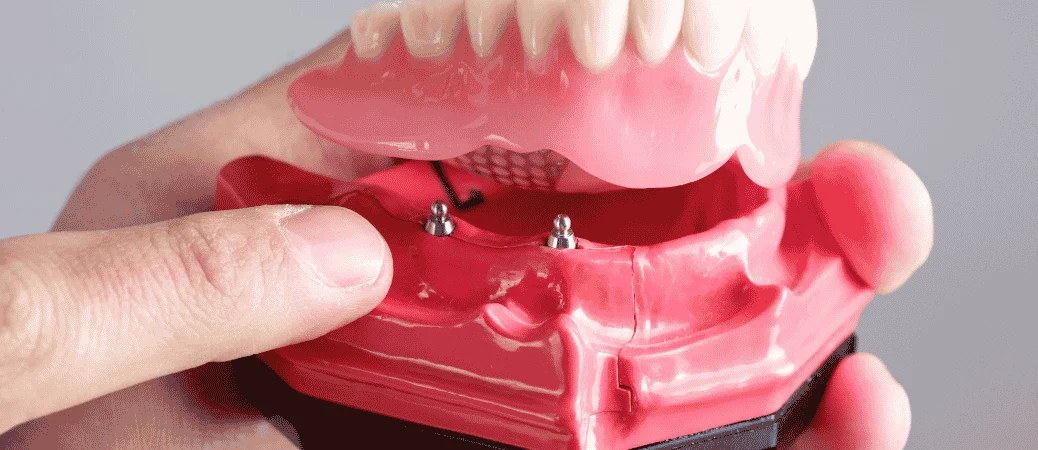
Snap-in dentures (removable overdentures that click onto two to four implants) generally cost less than fixed dentures that stay permanently attached and only come out in a dentist’s office.
A systematic review found that single-implant overdentures are less expensive than two-implant overdentures, and that two-implant overdentures cost less than fixed full-arch implant bridges.
Fixed full-arch options, including All-on-X dental implants, use implants to support a fixed restoration and generally require a larger initial investment than removable dentures.
If you’re weighing a full-arch option against something like a dental implant vs. bridge approach, the same removable-versus-fixed cost logic applies.
Which Choice Fits Your Budget and Dental Needs?
Your decision should rest on your bone health, your budget, and how many teeth you’re replacing, not on the lowest quote you can find.
A conversation with an experienced dentist about missing teeth, remaining bone, and daily habits will tell you more than any price list alone.

When Might Traditional Dentures Make More Sense?
Traditional dentures often make sense if you’re working with a tighter budget, need a partial denture or complete denture quickly, or have health conditions that complicate surgery.
They’re also a reasonable choice if you’ve had significant bone loss that would require extensive grafting before implants become possible.
If you’re still deciding between a full denture and a partial, our guide on full vs. partial dentures walks through how that choice gets made.
When Is an Implant-Supported Denture Worth Considering?
An implant-supported denture is worth considering if you want better chewing stability, you’re frustrated with a loose-fitting denture, or you’re thinking ahead to the next 15 to 20 years rather than just the next five.
It’s also worth a look if you have adequate jawbone density or are open to bone grafting.
Learning more about dental implants as a category, including how they’re placed and maintained, can help you walk into that consultation with better questions.
Choose Based on the Full Cost, Not Just the First Quote

Traditional dentures and implant-supported dentures both solve the same problem in different ways, and neither is the automatic right answer.
Traditional dentures generally cost less at the start but may involve ongoing expenses for relines, adjustments, adhesive, repairs, or replacement over time.
Implant-supported dentures generally require a larger initial investment, but their long-term costs depend on the type of restoration, maintenance needs, repairs, and the health of the implants and surrounding tissues.
The most useful next step is getting a written, itemized quote for both options, including imaging, extractions, and any grafting, so you can compare real numbers instead of estimates.
Frequently Asked Questions
How much does a full set of implant-supported dentures cost?
The cost of implant-supported dentures varies considerably because treatment is customized to each patient.
Factors include the number of implants needed, whether the restoration is removable or fixed, imaging, extractions, bone grafting, sedation, and the type of final restoration.
A personalized treatment plan provides a more useful estimate than a general price range.
Do snap-in dentures cost less than fixed implant dentures?
Yes, snap-in (removable) implant dentures generally cost less than fixed implant dentures because they use fewer implants and simpler attachments.
Fixed dentures stay permanently in place and typically involve more implants per arch, which raises both the surgical and material costs.
Research on overdenture treatment options confirms that single and two-implant overdentures cost less than comparable fixed restorations.
How long do implant-supported dentures last?
Dental implants are designed as a long-term tooth-replacement option, but their lifespan varies based on oral health, hygiene, bite forces, health conditions, and regular professional care.
The denture and attachment components may require maintenance or replacement over time.
What are the downsides of implant-supported dentures?
The main downside is the higher upfront cost, since implant-supported dentures require surgical implant placement and additional restorative components.
Treatment generally takes longer than traditional denture treatment because implant placement requires surgery and time for healing before the final restoration is completed.
Does dental insurance cover traditional or implant-supported dentures?
Dental insurance plans typically cover traditional dentures more readily than implants, though coverage varies by plan and provider.
It’s worth calling your insurance provider directly to ask what portion of either treatment they’ll cover before committing to a plan.