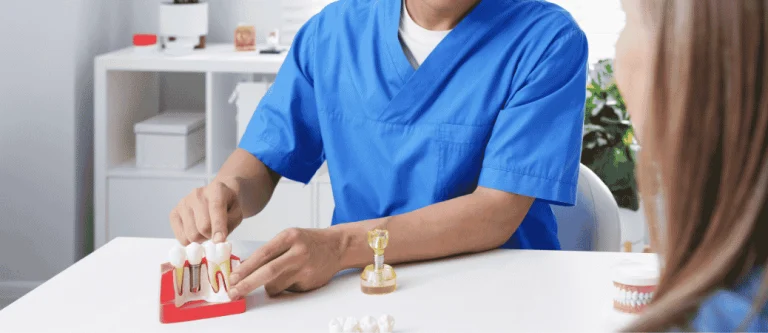
If you’re considering dental implants after 65, your overall health, jawbone, gum health, and medications usually matter more to treatment planning than your age alone.
Age by itself does not determine whether you are a good candidate for dental implants.
Your dentist will look at factors such as your general health, bone support, gum condition, medications, and ability to heal before recommending treatment.
If you are healthy enough for a routine dental procedure and have enough jawbone to support an implant, age alone may not prevent you from being considered for treatment.
What can change after 65 is the planning. Your medication list may need closer review, your healing needs will be considered carefully, and bone grafting may be recommended if there is not enough bone to support an implant.
For many older adults with missing teeth, dental implants remain an option worth discussing with a dentist based on their individual health and treatment needs.
Key Takeaways
- Your overall health, jawbone density, and gum condition decide candidacy, not your birth year.
- Implants replace the tooth root, which protects jawbone and chewing strength in ways dentures cannot.
- Daily cleaning and regular checkups are the biggest factors you personally control in long-term success.
Are You a Candidate at 65 or Older?
There is no upper age limit for dental implants in the United States, and the FDA sets none.
Your implant team looks at three things: how well your body heals, how much jawbone you have, and how healthy your gums are.
Why Health Matters More Than Chronological Age
A well-managed 78-year-old is a better candidate than a 55-year-old with uncontrolled diabetes and a pack-a-day habit. Healing capacity, not the number of birthdays, drives the outcome.
Well-managed health conditions may not automatically prevent implant treatment, but candidacy depends on individual health and healing factors.
If you smoke, your dental and medical teams may recommend stopping before and during healing to reduce treatment risks.
How Jawbone Density and Gum Health Affect Eligibility
An implant needs bone to grip. When a tooth is lost, the jawbone underneath begins to shrink, a process called bone resorption, and long-gap areas often have less width and height than they once did.
That is why a bone density assessment is part of every workup. Thin bone does not mean no, it means the plan may include grafting first.
Gum health carries equal weight. Active gum disease, especially advanced periodontitis, needs treatment before any implant goes in, since the same bacteria that loosened your natural teeth can attack an implant site.
Building strong daily hygiene habits before surgery gives the whole plan a better start.
Medical Conditions and Medicines Your Implant Team Needs to Review
Bring your full medication list to your first visit, including over-the-counter pills and supplements. Here is what your dentist is watching for and why.
| Condition or medicine | What it affects | Common approach |
| Diabetes | Healing and infection risk | Well-controlled A1C is often fine; uncontrolled diabetes is treated first |
| Heart disease | Surgery safety, blood pressure | Medical clearance from your physician |
| Osteoporosis | Bone quality at the implant site | Imaging guides site selection; often still a candidate |
| Autoimmune conditions (rheumatoid arthritis, lupus) | Healing speed, medication effects | Coordination with your rheumatologist |
| Blood thinners (aspirin, clopidogrel, warfarin) | Bleeding during surgery | Rarely stopped; timing and technique adjusted |
| Bisphosphonates (Fosamax and similar) | Small risk of osteonecrosis of the jaw | Route, dose, and duration reviewed carefully |
| Past chemotherapy or head radiation | Bone and tissue healing | Timing discussed with your oncology team |
If you take blood-thinning medication, your dentist will review it as part of treatment planning and may coordinate with your prescribing healthcare professional. Do not stop or change prescribed medication on your own.
Antiresorptive drugs deserve a careful conversation. Oral bisphosphonates taken for routine osteoporosis carry a low risk of osteonecrosis of the jaw; high-dose IV forms used in cancer care carry more.
Your dentist will want the name, dose, and how long you have taken it.
Which Tooth Replacement Option Is Right for You?
Implants come in three basic scales: one tooth, a section of teeth, or a full arch.
Each starts with the same core idea of replacing the root, and the right scale depends on how many teeth are missing and how much bone remains.
How an Implant Replaces a Natural Tooth Root
A dental implant is a small titanium post that your surgeon places into the jawbone, where it acts as an artificial tooth root. It looks a bit like a tiny screw.
On top of that post sits a connector called an abutment, and on top of that goes the visible artificial tooth, shaped and shaded to match your other teeth.
That root piece is what makes the difference. Chewing pressure travels down into the bone the way it did with your natural tooth, which helps prevent further jawbone deterioration and supports your facial structure over time.
Single Implants, Bridges, and Full-Arch Solutions
One missing tooth calls for a single tooth dental implant, which leaves the neighboring teeth untouched. A traditional bridge, by comparison, requires grinding down the healthy teeth on either side.
Several missing teeth in a row can be handled with an implant-supported bridge, where two implants carry three or four teeth.
If you are weighing the dental implant vs bridge decision, the trade-off comes down to protecting nearby teeth versus a shorter, less involved procedure.
For a full arch, four to six implants can anchor a fixed set of teeth.
All-on-X dental implants work this way, and a full-mouth rehabilitation plan may combine implants with other restorative work.
There is also a middle path many older adults appreciate: implant-supported overdentures. Two to four implants snap a removable denture into place, so it stays put while still lifting out for cleaning.
Dental Implants vs. Traditional Dentures
| Dental implants | Traditional dentures | |
| Holds jawbone in place | Yes | No, bone shrinks over time |
| Chewing strength | Close to natural teeth | Reduced, sticky and hard foods difficult |
| Slipping while eating or talking | No | Common without adhesive |
| Typical replacement interval | 10+ years, often decades | Every 5 to 7 years, plus relines |
| Upfront cost | Higher | Lower |
| Daily care | Brush and clean like natural teeth | Remove, soak, clean nightly |
Dentures still make sense for some people, especially when bone volume is very limited or a lower upfront cost is the priority.
If you are comparing full vs partial dentures, that conversation pairs naturally with asking whether a couple of implants could steady the appliance.
What Happens During Implant Treatment?
Implant treatment unfolds in stages across several months, with most of that time spent healing rather than in the chair.
A consultation and scan come first, then surgery, then a healing stretch before the final tooth goes on.
What to Expect at the Implant Consultation and Imaging Visit
Your first visit is mostly conversation and pictures. Your dentist reviews your health history, current medications, and what has been bothering you about eating or speaking.
Then comes imaging. Regular x-rays show the basics, but a 3D cone beam CT scan (CBCT) is what maps bone height, bone width, nerve position, and sinus location in three dimensions.
That scan is why planning at 65 looks different from planning at 40. It shows exactly where usable bone sits, so your team can place implants in the strongest spots and know in advance whether grafting is needed.
Come prepared with questions. The team at Gainesville Dentistry Co. encourages patients to bring a written list, and these questions to ask your dentist about restorative dentistry are a good starting point.
Dental Implant Surgery, Comfort Options, and Recovery
Placement surgery for a single implant takes about an hour and is done with local anesthesia. Most people are surprised by how ordinary it feels, closer to a filling than the operation they imagined.
Depending on your needs and the treatment planned, your dentist can discuss appropriate comfort and sedation options.
There is no reason to white-knuckle it, and there are practical ways to work through dental anxiety before your appointment.
Then comes osseointegration, the months-long process where bone grows tightly around the post to create implant stability.
This usually runs three to six months, and it may take a bit longer after 65 because bone turnover slows with age. The dental implant recovery timeline breaks down what each week looks like.
Soreness peaks in the first two or three days. Ice, soft foods, and prescribed pain relief handle most of it.
When Bone Grafting or Advanced Implant Designs May Help
Bone grafting adds volume where the jaw has thinned, and it is common for anyone who has been missing teeth for years.
Graft material goes into the site, then heals for three to six months before the implant is placed. Some cases allow grafting and placement on the same day.
A sinus lift is a specific graft for the upper back jaw, where the sinus floor sits low and leaves too little bone for a standard implant.
Reading up on bone graft before dental implant will make that recommendation less startling if it comes up.
When bone loss is severe, other designs exist. Mini dental implants use a narrower post and are often used to stabilize a lower denture.
Subperiosteal implants rest on top of the jawbone for people with very low bone height, and zygomatic implants anchor into the cheekbone for advanced upper-jaw loss.
Longstanding gaps do not rule you out. Getting dental implants after years of missing teeth is routine, it just adds a grafting step for many patients.
How Can You Support Long-Term Implant Success?
Daily cleaning and steady dental visits are the two factors most within your control, and they matter more than anything else after the implant heals.
Good daily cleaning and regular dental visits can help reduce the risk of gum inflammation and infection around an implant.

What Implant Success Rates Mean for Older Adults
Implants succeed about 97% of the time at 10 years and 75% at 20 years.
Age 65 and up does not move those numbers much; a review of studies from 2022 through 2026 found success rates for older adults essentially matching younger patients.
One realistic note: patients over 80 show a slightly higher rate of complications, though still low. That reflects health conditions and medications more than the birthday itself.
For a sense of what to expect over the decades, how long a dental implant lasts depends more on the gum tissue around it than on the titanium post.
Daily Cleaning Habits That Protect Gums and Implants
An implant cannot get a cavity, but the gum and bone holding it absolutely can get infected.
That infection is called peri-implantitis and can threaten the gum and bone supporting an implant if it progresses.
Here is a routine that works, especially for hands with arthritis:
- Electric toothbrush, twice daily. The oscillating head does the work your wrist would otherwise have to do.
- Water flosser, once daily. Easier than string floss around implant crowns and bridges, and gentle on gums.
- Interdental brushes for wider gaps and under bridge work.
- Dental checkups every three to six months, with professional cleaning around the implant.
Skip the picks and abrasive pastes unless your hygienist recommends them, since scratching the implant surface gives bacteria a foothold.
Warning Signs That Need Prompt Dental Care
Call your dentist rather than waiting for your next scheduled visit if you notice any of these:
- Gums around the implant that bleed, swell, or look red
- Any looseness or movement in the implant or crown
- Pain or tenderness that starts months or years after healing
- Gum tissue pulling back so the metal post shows
- A bad taste or persistent odor near the implant
- Discomfort when biting on that tooth
Caught early, peri-implantitis is treatable. Caught late, it can mean losing the implant, so a quick call to Gainesville Dentistry Co. is worth making even if the symptom seems small.
How Much Do Dental Implants Cost After 65?
The cost of dental implant treatment varies based on how many implants you need, the type of restoration, and whether preparatory procedures such as bone grafting are required.
What Changes the Cost of Dental Implants
Four things drive the price: the number of implants, their location in the jaw, the type of restoration on top, and whether you need preparatory procedures.
Bone grafting adds cost. A sinus lift adds more. Both are common after 65 and are often the difference between a plan that works and one that fails.
Full mouth dental implants and full arch implants cost more upfront than implant-supported dentures, since fixed teeth require more implants and more lab work.
Snap-in overdentures on two implants sit at a lower price point while still solving the slipping problem.
Financial Options for Implant Treatment
Dental implant costs depend on the number of implants, the type of restoration, and whether procedures such as bone grafting are needed first.
Ask about payment plans, third-party financing, and any membership plans the practice offers.
Comparing Upfront Cost With Long-Term Value
Dentures cost less at the start and more over time. They need relines as the jaw shrinks, and full replacement every five to seven years.
Implants outlast alternative solutions in most cases, with no need for replacement for at least a decade. Add the bone preservation, and the math shifts over a 15 or 20-year horizon.
There is also the part that does not show up on an invoice: eating an apple, a steak, or corn on the cob without planning around it.
For many people that quality of life change is the deciding factor.
Making a Confident Choice at Any Age

Dental implants for seniors succeed at nearly the same rate as they do for younger adults, so the question is never whether you are too old.
It comes down to your overall health, the bone in your jaw, the state of your gums, and your ability to keep up with cleaning.
Get your medication list together, ask your physician about clearance if you have a heart condition or take an antiresorptive drug, and book an implant consultation that includes 3D imaging.
That scan will answer the bone question in a way no article can.
Whether the plan turns out to be one implant, a snap-in overdenture, or a full arch, the goal is the same tooth replacement that lets you eat and speak without thinking about it.
The team at Gainesville Dentistry Co. is accepting new patients who want that evaluation.
Frequently Asked Questions
At what age should you stop getting dental implants?
There is no upper age limit for dental implants, and the FDA does not set one.
Successful placements happen routinely in patients in their 70s and 80s, with your health status and jawbone volume determining candidacy.
Are dental implants worth it for seniors?
For most healthy older adults, yes, because implants restore close to natural chewing strength and stop the jawbone shrinkage that dentures allow.
They cost more upfront, though most last well over a decade compared with dentures needing replacement every five to seven years.
Can someone with osteoporosis get dental implants?
Yes, osteoporosis by itself does not rule out implants, since jawbone density often differs from hip or spine density.
Your dentist will review any bisphosphonate or other antiresorptive medication you take, because the drug matters more than the diagnosis when assessing risk to the jaw.
Do blood thinners prevent you from getting dental implants?
Blood thinners rarely prevent implant surgery, and most patients continue their medication through the procedure.
Your dentist coordinates with your prescribing physician on timing and uses techniques to control bleeding, so never stop aspirin, clopidogrel, or warfarin on your own.
Does Medicare pay for dental implants for seniors?
Original Medicare does not cover dental implants or routine dental care.
Certain Medicare Advantage plans include dental benefits that may offset part of the cost, so check your specific plan’s annual dental maximum and whether implants are an eligible service.
What should I know before choosing dental implants after 65?
Know your full medication list, your gum health status, and whether you have enough jawbone, which a 3D cone beam CT scan will show.
Plan for a treatment span of several months, since healing after 65 sometimes takes a few extra weeks, and budget for possible bone grafting.
A consultation at Gainesville Dentistry Co. can give you those specifics for your own mouth.