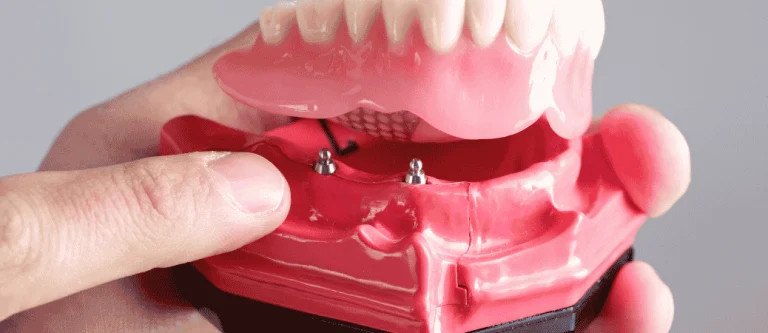
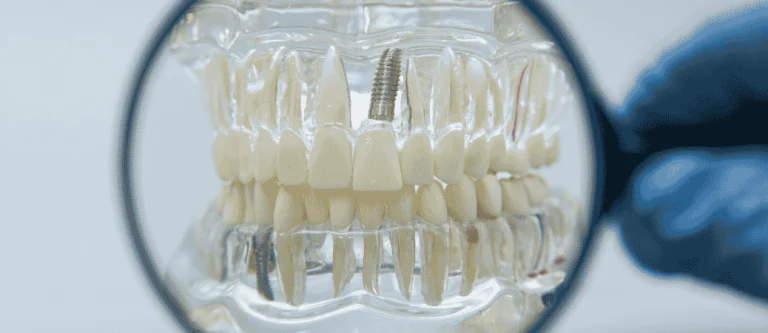
Food that wedges into the same spot beside your implant after nearly every meal is more than a nuisance. It is a sign that something about the space between the crown and the next tooth has changed.
You may have gone years with no trouble, so a sudden food trap can feel worrying.
Food getting stuck around dental implant crowns can result from an open gap between the crown and neighboring tooth, natural tooth movement, crown shape, or changes in the surrounding gum tissue.
Careful cleaning can remove trapped food, but it cannot correct an underlying gap or problem with the crown’s fit.
Food impaction typically occurs around the implant crown, between neighboring teeth, or near the gumline. In a healthy, healed implant, the surrounding tissues help protect the implant post.
However, deeper pockets caused by peri-implant disease may allow debris to collect below the gumline.
Key Takeaways
- A repeat food trap beside an implant usually comes from a gap, a shifted tooth, crown shape, or gum changes.
- Gentle tools like interdental brushes and water flossers clear food, but a dentist has to fix the gap itself.
- Bleeding, swelling, pus, or a loose crown call for a prompt visit, though food trapping alone does not mean your implant is failing.
Which Changes Can Create a Food Trap?
Most food traps beside an implant come from small changes in how the crown, the neighboring tooth, and the gum fit together over time.
A tooth that drifts a fraction of a millimeter, a gum that pulls back slightly, or a crown screw that loosens can each open a space that chewing forces food into.
An Open Contact Between the Crown and Neighboring Tooth
The interproximal contact is the spot where your implant crown touches the tooth beside it. When it is snug, floss snaps through with a little resistance and food slides off the chewing surface.
When it opens, even slightly, chewing pushes food straight down into the gap.
Dentists call this an open proximal contact. An open gap next to an implant crown can lead to a food trap and decay on the neighboring tooth, since that tooth’s side surface is hard to keep clean.
A common clue is floss that suddenly drops through with no “snap.” Another is stringy food, like meat or celery, lodging in the exact same spot.
Natural Tooth Movement Beside a Fixed Implant
Natural teeth are supported by a periodontal ligament, which allows small movements over time. In contrast, dental implants integrate directly with the jawbone and do not move in the same way as natural teeth.
These differences can allow a contact between an implant crown and neighboring tooth to open over time.
Research on food impaction around dental implants identifies movement of neighboring natural teeth as one factor that can contribute to open contacts beside implant-supported crowns.
A review of studies found proximal contact loss between implant crowns and adjacent natural teeth is a common finding over time and a key reason for food impaction.
This explains why an implant that felt perfect for years can start catching food.
If you had dental implants after years of missing teeth, the nearby teeth may already have tilted before treatment, which affects how the contact holds up.
Crown Contours That Collect Food
The shape of the crown’s sides guides food during chewing. A well-curved side pushes food up and away. A flat or hollow side lets food slip into the space below the contact point.
The way the crown comes out of the gum (the emergence profile) matters too. The implant’s position, crown contours, and surrounding gum tissue can influence the shape of the space near the gumline.
Certain restoration designs may leave areas where food collects or becomes difficult to remove.
Tell your dentist which one you notice. “Between the teeth” and “near the gum under the crown” point toward different fixes.
Gum Recession and a Reduced Gum Papilla
The little triangle of gum that fills the space between two teeth is called the interdental papilla. When it shrinks, a dark triangle opens below the contact, and food collects there.
The gum around an implant, called peri-implant tissue, attaches differently than gum around a natural tooth. It forms a cuff, or peri-implant seal, without the same fibers that anchor gum tightly to a tooth root.
These differences in tissue attachment make effective plaque control and regular professional monitoring particularly important around dental implants.
Inflammation or bone remodeling may also affect the shape of the surrounding gum tissue.
Bite Changes or a Loose Crown Component
Your bite shifts as teeth wear, fillings change, or teeth move. A new pattern of contact can wedge food into a gap that used to stay clear.
A loose crown or abutment screw can also open the contact. You might feel a faint click, a slight wiggle, or a crown that seems “different” when you bite.
Movement around an implant crown may involve a loose screw, abutment, or another restorative component.
A loose dental implant or crown should be evaluated promptly to determine which component is moving and whether repair is possible.
How Can You Remove Trapped Food Safely?
The safest way to clear food from beside an implant is to loosen it with water first, then use a soft tool sized for the space. Force is never needed.
Sharp objects, metal picks, and toothpicks can scratch the crown or tear the gum seal, so keep them out of the area.
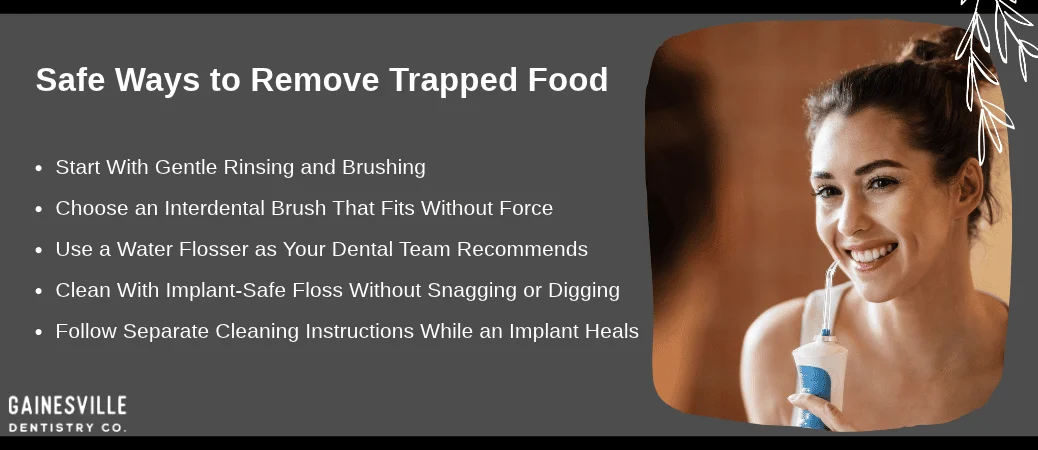
Start With Gentle Rinsing and Brushing
Swish warm water firmly around the area for 20 to 30 seconds. A pinch of salt in a cup of warm water also helps soothe irritated gum. Rinsing alone frees a lot of trapped food.
Next, use a soft-bristled toothbrush angled toward the gumline. Use small circles with light pressure. If you notice bleeding, avoid increasing brushing pressure or scrubbing the area.
Continue gentle cleaning as recommended by your dental team, and arrange an examination if bleeding persists or occurs repeatedly.
Skip charcoal or gritty whitening pastes around the crown. They can dull and scratch the surface, which makes plaque stick more easily.
More everyday habits that help are covered in these five tips for boosting your dental hygiene.
Choose an Interdental Brush That Fits Without Force
Interdental brushes look like tiny bottle brushes. Interdental brushes may be particularly helpful for cleaning open spaces below the contact point where conventional floss may not reach effectively.
Size is the key detail. The brush should slide in with light contact on both sides. If you have to push or bend the wire, it is too big. If it moves freely with no bristle contact, go up one size.
- Pick brushes with a plastic-coated wire, which is gentler on the crown.
- Move the brush in and out two or three times, then rinse it.
- Ask your hygienist to size your gap at your next visit, since many people need two sizes for different spaces.
Use a Water Flosser as Your Dental Team Recommends
Water flossers push a pulsing stream of water into gaps and along the gumline. Many implant patients find them easier than floss, especially around crowns in the back of the mouth.
Start on a low setting. Aim the tip along the gumline at a slight angle and pause briefly at the gap between the crown and neighboring tooth. Avoid blasting straight down into the gum at full power.
A water flosser clears debris. It does not close an open contact, so if food packs back in at the next meal, the gap still needs attention.
Clean With Implant-Safe Floss Without Snagging or Digging
Some implant-specific floss products feature thicker or spongier sections designed to clean around restorations.
Floss threaders may also help you reach certain areas, depending on your crown design and your dentist’s recommendations.
Wrap the floss in a C-shape around the crown and slide it gently up and down. Then do the same against the neighboring tooth, since that natural tooth can decay where food sits.
Pay attention to what the floss tells you:
- Snaps through easily with no resistance: the contact may have opened.
- Catches or shreds: there may be a rough edge, a ledge, or a problem at the crown margin.
- Will not pass at all: something has changed in tightness, so do not force it.
Follow Separate Cleaning Instructions While an Implant Heals
A new implant site follows different rules. In the weeks after surgery, the gum is still sealing around the implant, and strong water pressure or firm brushing can disturb it.
Follow the exact instructions your implant dentist gives you, which may include a prescription rinse, a very soft brush, and no water flosser until healing is confirmed.
Softer foods during this stage help keep debris away from the healing gum. Once your dentist clears you, you can move to your regular routine.
When Does Food Trapping Need Dental Attention?
Any food trap that returns after most meals is worth a dental check, even with no pain. Recurring food trapping deserves a dental examination, even when there is no pain.
Bleeding, swelling, pus, or movement around the implant may indicate a problem that requires prompt professional evaluation.
Repeated Packing or Shredding Floss Deserves a Check
Food that packs into the same spot daily points to a structural change. Good cleaning keeps the area healthy, but the gap stays open no matter how well you floss.
Book an exam if you notice any of these:
- Food lodges in the same gap after most meals
- The space looks new or larger
- Floss shreds, catches, or drops through loosely
- You need tools every day just to feel comfortable
Tell your dentist which foods tend to get trapped and where you notice the problem. These details can help identify whether the issue involves the contact point, crown contours, or surrounding gum tissue.
Bleeding, Swelling, Pus, or Looseness Needs Prompt Assessment
Some signs mean the gum around the implant is inflamed or the hardware has shifted. Call your implant dentist soon if you have:
- Bleeding when you brush or floss near the implant
- Red, puffy, or tender gum
- Pus or a bad taste from that spot
- Pain when you chew
- A crown that feels loose or moves
Seek urgent dental care if you develop fever, facial swelling, or severe or worsening pain. If swelling spreads rapidly or you have difficulty breathing or swallowing, seek emergency medical care immediately.
If you experience severe or worsening symptoms, seek emergency dental care to have the implant and surrounding tissues evaluated promptly.
How Peri-Implant Mucositis Differs From Peri-Implantitis
Peri-implant mucositis is inflammation of the soft tissues surrounding an implant without additional bone loss beyond initial healing and remodeling.
With appropriate professional care and improved plaque control, the inflammation can often be resolved.
Peri-implantitis involves inflammation plus loss of the bone that supports the implant. It is harder to treat, and without care it can lead to implant failure.
| Peri-implant mucositis | Peri-implantitis | |
| Affects | Gum only | Gum and bone |
| Common signs | Bleeding, redness, puffiness | Same signs, plus deeper pockets, pus, bone loss on X-ray |
| Outlook | Reversible with care | Treatable, harder to reverse |
The driver of both is bacterial plaque, not trapped food alone. Food that sits in a gap feeds that plaque, which is why the gap matters.
Early evaluation and appropriate periodontal care can help manage inflammation and reduce the risk of further damage to the supporting tissues.
How Does a Dentist Identify and Fix the Cause?
A dentist finds the cause by checking each possible factor in order, then matches the repair to what is found.
The fix might be a small bonding addition, a crown adjustment, a tightened screw, or treatment of inflamed gum, and some cases need more than one step.
Checking the Contact, Bite, Crown Stability, and Supporting Tissues
Your implant dentist will usually start with floss. How it passes through the contact shows whether the gap is open, tight, or rough.
Next comes the rest of the picture:
- Bite: marking paper shows how your teeth meet and whether chewing drives food into the gap.
- Crown stability: the dentist checks for any wiggle in the implant crown or abutment.
- Gum and peri-implant tissue: gentle probing measures pocket depth and checks for bleeding.
- X-rays: these show bone levels around the implant and check the neighboring tooth for decay.
The neighboring tooth gets its own check too. Decay, a worn filling, or cracked teeth beside the implant can open a contact just as easily as movement can.
Repairing an Open Contact or Modifying the Crown
For a small open contact, many dentists add a thin layer of tooth-colored bonding to the side of the neighboring natural tooth. This rebuilds the touch point without removing the implant crown.
Repair options depend on the design and condition of your restoration. Crowns used with single-tooth dental implants may sometimes be modified to improve contact with the neighboring tooth.
In other cases, a replacement crown with more suitable contours may be recommended.
Expect honesty about limits. Because natural teeth keep moving, a repaired contact can open again years later and need another adjustment.
Addressing Loose Components and Treating Inflammation
A loose abutment screw may be tightened or replaced after your dentist checks the condition of the implant, crown, and other restorative components.
When the gum is inflamed, treatment starts with a careful professional cleaning using instruments that won’t scratch the implant.
Your hygienist may change your home tools and show you a new technique. Deeper bone loss from peri-implant disease may call for more advanced gum treatment.
Regular dental cleanings and exams let your team confirm the gum has calmed down after any repair.
What Helps Prevent Food Traps From Returning?
Daily cleaning suited to your implant and regular dental checkups can help control plaque, identify changes in crown fit, and detect recurring food traps before they become more difficult to manage.

Keep a Daily Cleaning Routine Matched to Your Implant
Brush twice a day with a soft brush, paying attention to the gumline around the crown. Once a day, clean between the crown and neighboring tooth with the tool that fits your space.
For most people with dental implants, that means one of these:
- An interdental brush for an open triangle below the contact
- Implant floss or a threader for tighter spaces
- A water flosser, alone or alongside a brush, if your hands find floss hard
Ask your hygienist to watch you clean once. Small changes in angle often make a big difference, and your routine can shift as your gum health changes.
Monitor Changing Gaps and Keep Personalized Maintenance Visits
Pay attention to small changes. If floss starts snapping through more easily or food begins catching where it never did, mention it at your next visit or sooner.
Many implant patients do well with professional cleanings every three to six months. The right interval depends on your gum health, plaque buildup, and history of implant problems.
Routine general preventative dentistry visits also give your dentist a chance to compare X-rays over time and spot drift before it turns into a daily problem.
Manage Foods That Catch Without Unnecessary Dietary Restrictions
Stringy meats, popcorn hulls, seeds, and leafy greens are the usual troublemakers. You can still eat them. Chewing on the other side, cutting meat into smaller pieces, and rinsing with water after meals all help.
Keep a small travel kit with an interdental brush or floss for meals out. If you find yourself avoiding many foods to stay comfortable, that is a sign the gap needs repair.
Keep the Area Clean and Get Recurring Gaps Checked
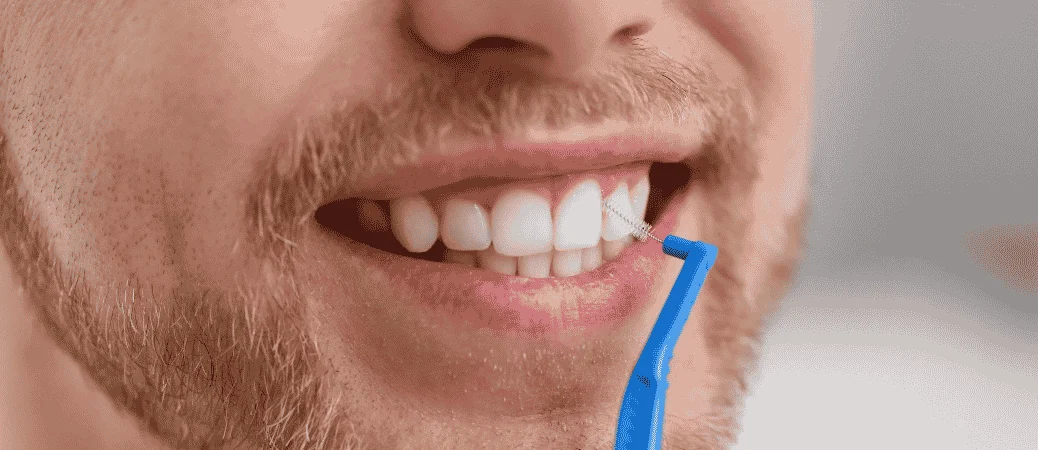
Recurring food impaction beside an implant points to a change in fit, and fixing it starts with a dental exam.
At home, rinse first, then use a soft brush, a properly sized interdental brush, a water flosser, or implant floss, and never force a tool into the gap.
A trap that returns after most meals deserves an appointment, even without pain.
Bleeding, swelling, pus, or movement around the implant should prompt earlier professional evaluation, particularly if symptoms are persistent or worsening.
At Gainesville Dentistry Co., Dr. Greg Feldman can evaluate your implant crown, neighboring teeth, bite, and supporting tissues to determine why food keeps getting trapped.
Based on the findings, he can recommend appropriate treatment to improve the fit of your restoration and protect your oral health.
Frequently Asked Questions
Can food get beneath the implant post, or is it caught around the crown?
Food is caught around the implant crown, either in the gap beside the neighboring tooth or near the gumline.
A healthy, healed implant is sealed by gum and fused to bone, so food does not travel down along the post. Deep pockets from gum disease can hold debris, which is one reason bleeding or swelling needs a check.
Why did food start getting stuck years after my implant was placed?
Your natural teeth keep shifting slowly while the implant stays fixed in bone, so the contact between them can open over time.
Gum recession, bite changes, and a loosened crown screw can also cause a late-starting food trap. An exam shows which one applies to you.
Will a gap between my implant crown and neighboring tooth close on its own?
An open contact generally does not resolve without addressing the underlying cause, and the space may change further as neighboring teeth move.
Your dentist can determine whether bonding, crown modification, or replacement may help restore the contact.
What should I do if trapped food causes pain and will not come out?
Rinse with warm salt water, then try a water flosser on low or a properly sized interdental brush, and stop if you need to push hard.
Avoid toothpicks and sharp objects near the gum. If the food stays stuck or the pain grows, call your dentist that day; our guide on how I know I am having a dental emergency helps you judge urgency.
Does food trapping mean my dental implant is failing?
Food trapping alone does not mean your implant is failing, since most cases involve the crown and the space around it.
Untreated peri-implantitis is one possible cause of implant failure because it can damage the bone supporting the implant. Other biological and mechanical complications can also affect implant health.
Keeping the area clean and having recurring food traps evaluated can help protect the surrounding tissues.